- Tokyo : 20:20 |
- Singapore : 19:20 |
- Dubai : 15:20 |
- London : 12:20 |
- New York : 07:20 |
- Sydney : 21:20

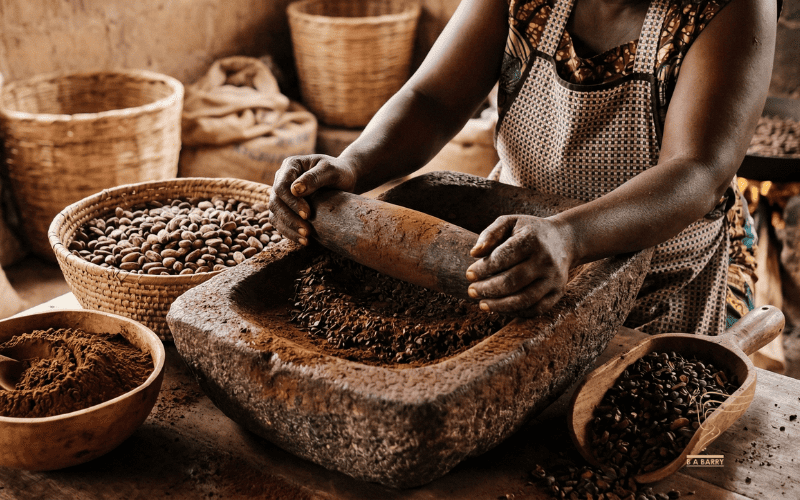
Cocoa bean processing is a precise, multi-stage operation that transforms raw tropical fruit into one of the world's most in-demand food ingredients. For food manufacturers, chocolatiers, and bulk importers, understanding this process isn't just interesting — every stage directly determines the colour, fat content, pH, flavour profile, and shelf life of the cocoa powder that arrives at your facility.
This guide walks through all 12 processing steps and — critically for buyers — explains what each stage means for powder quality, how to read a supplier's Certificate of Analysis against it, and what specification flags to watch for.
Cocoa trees (Theobroma cacao) grow within 20 degrees of the equator, with the largest producing regions being West Africa (Ivory Coast, Ghana), South America (Brazil, Ecuador), and Southeast Asia (Indonesia).
Harvesting is done entirely by hand. Workers use machetes or long-handled tools to cut ripe pods directly from the trunk and main branches without damaging the tree. A single tree yields around 20–30 pods per year, each containing 20–50 cocoa beans surrounded by white pulp.
Why it matters: Harvesting at the right moment of ripeness directly affects fermentation outcomes and final flavour profile. Overripe or underripe pods produce inferior beans.
Once harvested, pods are split open — again by hand — and the wet, pulp-covered beans are scooped out. This must happen quickly, typically within a few hours of cutting, to prevent spoilage.
At this stage the beans are cream or purple in colour and have no chocolate flavour whatsoever. The transformation begins in the next step.
Step 3: Fermentation — The Most Critical Stage
Fermentation is arguably the most important step in cocoa bean processing. The beans, still coated in pulp, are piled into wooden boxes or heaped under banana leaves and left to ferment for 5 to 7 days.
During this time, two processes occur simultaneously:
External fermentation: Yeasts and bacteria break down the sugary pulp, producing heat and ethanol
Internal fermentation: Enzymes inside the bean break down proteins and sugars, developing precursors to the complex flavours we associate with chocolate
Fermentation also kills the seed, stopping germination, and reduces bitterness. Beans are turned regularly to ensure even fermentation and oxygenation.
Under-fermented beans produce harsh, astringent cocoa powder. Over-fermented beans develop off-flavours. Getting this stage right is what separates premium cocoa from average grade.
Buyer checkpoint: Ask suppliers for cut-test reports or fermentation level documentation. A reputable origin supplier should be able to confirm fermentation percentage. Cocoa powder made from under-fermented beans will show higher astringency and lower flavour complexity in the COA sensory notes.
After fermentation, beans still contain around 55–60% moisture. They need to be dried down to approximately 7–8% moisture to prevent mould growth during transport and storage.
There are two main drying methods:
Sun drying: Beans are spread on raised platforms or mats in direct sunlight for 5–14 days. This is the preferred method as it preserves flavour and produces a superior end product.
Mechanical drying: Used when the weather doesn't cooperate. Temperature must be carefully controlled — excessive heat at this stage can cause off-flavours, including smoky or hammy notes.
Properly dried beans are brown, firm, and have a pleasant nutty-chocolate aroma. They are then bagged in jute or sisal sacks and prepared for export.
Buyer checkpoint: Moisture content should be confirmed at ≤7.5% on arrival. Mechanical drying at incorrect temperatures introduces smoky or hammy off-notes — ask your supplier whether sun-drying or mechanical drying was used, particularly for premium-grade orders.
At origin or upon arrival at processing facilities, beans go through mechanical cleaning to remove stones, dust, dirt, and foreign material. They are then graded based on:
Bean size and uniformity
Percentage of mouldy, flat, or germinated beans
Cut test results (checking internal colour and fermentation level)
Moisture content
The ICCO (International Cocoa Organisation) sets global standards for cocoa grading. Grade 1 beans have less than 5% defects, while Grade 2 allows up to 10%.
Buyer checkpoint: Always request the bean grade (Grade 1 vs Grade 2) and a defect percentage figure from your supplier. This is the upstream quality gate — defect levels at this stage directly affect microbial counts, flavour consistency, and colour uniformity in the final powder.
Roasting is where the magic of flavour development truly happens. Cleaned beans are roasted at temperatures between 120°C and 150°C for 30 to 45 minutes, depending on the bean variety and the desired flavour profile.
The Maillard reaction — the same process that browns bread and caramelises onions — occurs during roasting, creating hundreds of new flavour and aroma compounds. Roasting also:
Loosens the shell (husk) from the bean
Reduces microbial load and moisture further
Enhances colour depth, contributing to the characteristic dark brown of cocoa powder
Light roast preserves fruity, acidic notes. Dark roast produces deeper, more bitter chocolate flavours. The roast profile is one of the key ways processors differentiate their cocoa powder products.
Buyer checkpoint: Roast profile is rarely disclosed on a standard COA, but it's worth asking about. If you're sourcing for beverage applications where fruity, bright flavour notes are needed, specify a lighter roast profile. For dark chocolate or confectionery coatings, a deeper roast is typically preferred.
After roasting, beans are passed through a winnowing machine that cracks them open and uses air currents to separate the lightweight shell (husk) from the heavier nibs inside.
Cocoa nibs are the pure, edible cocoa kernels. They contain roughly 50–55% cocoa butter (fat) and are the raw material for everything that follows — chocolate, cocoa liquor, cocoa butter, and cocoa powder.
The husks are not wasted — they are often used as mulch, animal feed, or in the production of cocoa husk tea.
Cocoa nibs are ground using heavy-duty mills. The grinding generates heat through friction, which melts the cocoa butter within the nibs. The result is a thick, dark, fluid paste called cocoa liquor — also known as cocoa mass or unsweetened chocolate.
Despite the name, cocoa liquor contains no alcohol. It is simply the liquid form of ground cocoa nibs, containing both cocoa solids and cocoa butter in their natural proportions.
At this point, processors have a choice: use the liquor as-is to make chocolate, or continue the process to separate the components and produce cocoa powder.
To make cocoa powder, the cocoa liquor must have most of its fat removed. This is done using a hydraulic press (the Broma process), which applies enormous pressure — sometimes over 6,000 PSI — to squeeze the cocoa butter out of the liquor.
What remains is a dry, compact disc called cocoa cake, which still retains around 10–24% fat depending on the degree of pressing.
High-fat cocoa powder (22–24% fat): Richer, more intense flavour. Used in premium applications.
Low-fat / fat-reduced cocoa powder (10–12% fat): More economical, longer shelf life. Common in industrial food production.
The extracted cocoa butter is equally valuable — it goes into chocolate manufacturing, cosmetics, and pharmaceuticals.
Buyer checkpoint: Fat content is one of the most important spec points in cocoa powder. High-fat powder (22–24%) delivers richer flavour and is preferred for premium confectionery and ice cream bases. Low-fat powder (10–12%) is more economical and better suited for dry mixes, beverages, and flavour coatings where fat content must be controlled. Always confirm fat percentage on the COA before ordering.
Not all cocoa powder undergoes this step, but it significantly affects the final product. Alkalization — commonly known as Dutch processing — involves treating the cocoa with an alkaline solution (usually potassium carbonate) either at the nib, liquor, or powder stage.
The effects of alkalization:
Raises pH from ~5.5 (natural) to 6.8–8.5
Produces a darker, more uniform colour (from reddish-brown to deep mahogany or near-black)
Mellows flavour — less acidic, smoother, more chocolatey
Improves solubility in liquids
Dutch-process cocoa powder is widely used in chocolate beverages, ice creams, dark cookies, and European-style confectionery. Natural (non-alkalized) cocoa is preferred in recipes using baking soda, as its acidity is needed for the leavening reaction.
Buyer checkpoint: Specify your required pH range upfront. Natural cocoa powder typically runs pH 5.0–5.5; lightly alkalized runs 6.5–7.2; heavily alkalized (dark/black grades) can reach 7.5–8.5. Getting this wrong affects both end-product flavour and — if you're supplying bakeries — leavening chemistry. Colour can serve as a visual indicator: reddish-brown signals natural or light alkalization; deep mahogany or near-black signals heavy Dutch processing.
The cocoa cake is broken up and milled into fine powder using pin mills or hammer mills. The powder is then sieved to achieve a consistent particle size — typically less than 75 microns for food-grade cocoa powder.
Particle size directly affects:
Mouthfeel and texture in end products
Solubility when mixed into beverages
Colour intensity in visual applications like frostings or coatings
Buyer checkpoint: For beverage applications, request particle size confirmation of ≤75 microns. Coarser grinds dissolve poorly and leave residue in hot drinks. If your application is a premium hot chocolate or chocolate syrup, some processors offer ultra-fine grinds below 50 microns — this is worth specifying.
Before packaging, cocoa powder undergoes rigorous quality testing, including:
Microbial analysis (Salmonella, E. coli, Total Plate Count)
pH and moisture content checks
Fat content verification
Heavy metal screening (cadmium is a concern in some cocoa origins)
Colour and flavour profiling
Cocoa powder is packed in multi-layer paper bags or Kraft bags of 25kg, often with a polyethylene inner liner to prevent moisture absorption. Bulk orders are palletised and shrink-wrapped for container shipping.
| Stage | What Happens | Key Quality Signal for Buyers |
| Harvest | Pods cut by hand at peak ripeness | Origin region and harvest season affect flavour profile |
| Fermentation | 5–7 days; develops flavour precursors | Request fermentation level (%) and cut-test data |
| Drying | Moisture reduced to 7–8% | Confirm sun-dried vs mechanical; check for off-notes |
| Cleaning & Grading | Defects removed; ICCO grading applied | Request Grade 1 or Grade 2 certificate and defect % |
| Roasting | Maillard reaction; flavour development | Ask for roast profile if flavour specificity matters |
| Winnowing | Shell removed; nibs separated | Shell content in nibs affects final powder purity |
| Grinding | Nibs become cocoa liquor | Liquor purity affects downstream flavour and fat yield |
| Pressing | Cocoa butter separated from cocoa cake | Specify fat % needed (10–12% or 22–24%) |
| Alkalization | pH raised; colour darkened (optional) | Specify pH range (5.0–8.5) and colour grade |
| Milling & Sieving | Cocoa cake milled to fine powder | Request particle size confirmation (≤75 microns standard) |
| Quality Testing | Microbial, pH, fat, moisture checks | Always request full COA before first order |
| Packaging | 25kg bags; polyethylene liner | Confirm inner liner type for moisture-sensitive applications |
Knowing the 12 steps above puts you ahead of most buyers. But knowing what questions to ask at each stage — and what to look for on a Certificate of Analysis — is what separates buyers who get consistent product from those who end up with spec mismatches after the first shipment.
A standard cocoa powder COA will include: moisture content, pH, fat content, particle size, colour (L*, a*, b* values), microbial results, and sometimes heavy metal data. Here's how each maps back to the processing steps:
Moisture (target: ≤5%) — Output of drying (Step 4) and final packaging (Step 12). Values above 5% indicate either inadequate drying at origin or a packaging issue.
pH (natural: 5.0–5.5; alkalized: 6.5–8.5) — Determined entirely by alkalization (Step 10). If your application requires a specific pH, state it before ordering.
Fat content (low-fat: 10–12%; high-fat: 22–24%) — Set by press pressure in Step 9. This is the most commercially significant spec point.
Particle size (standard: ≤75 microns) — Controlled in Step 11. Affects texture, solubility, and visual appearance.
Colour (L, a, b*)** — Affected by roast depth (Step 6), alkalization level (Step 10), and bean origin. Lower L* values indicate heavier alkalization and a darker powder.
Microbial counts (Salmonella: absent; TPC: ≤10,000 cfu/g typical) — Product of roasting (Step 6) and hygienic processing through Steps 7–12.
One of the most common buyer questions: what is the yield of cocoa powder from cocoa cake?
The yield depends on fat content. When cocoa liquor (roughly 50–55% fat) is pressed, the degree of pressing determines how much fat is removed:
Pressing to 22–24% residual fat yields approximately 65–70% cocoa powder from the original liquor weight
Pressing to 10–12% residual fat yields approximately 50–55% cocoa powder from the original liquor weight
The remainder is cocoa butter — a high-value product sold separately
For procurement planning, this means low-fat cocoa powder is harder to produce (more pressing required, lower yield) and is therefore typically priced higher per tonne than high-fat variants, despite appearing less rich. This is counterintuitive but important when comparing supplier quotes.
Origin matters most at the fermentation and drying stages (Steps 3 and 4), because farming infrastructure and climate differ significantly:
Ivory Coast (Côte d'Ivoire): The world's largest cocoa producer, responsible for approximately 38% of global output. Forastero bean dominant. Consistent flavour profile, reliable supply, ideal for large-volume industrial procurement. Most Dutch-process cocoa powder sourced globally originates here.
Brazil (Bahia/Pará): Known for more complex, nuanced flavour profiles due to post-harvest technique refinement. Preferred for premium confectionery applications where single-origin traceability adds commercial value.
Ghana: High-quality, fully fermented Forastero beans. Strict government export standards (COCOBOD) mean defect rates are consistently low — a reliable choice for buyers who prioritise Grade 1 consistency.
Indonesia: High volume, lower price point. Often used for commodity-grade cocoa powder in mass-market applications. Fermentation standards are more variable; request cut-test documentation when sourcing from Indonesian origin.
Understanding cocoa bean processing gives buyers a significant advantage when sourcing. Every stage of the process — from fermentation to pressing to alkalization — influences the final product's colour, pH, fat content, flavour intensity, and shelf life.
When you receive a Certificate of Analysis from a cocoa powder supplier, you're reading the output of all 12 steps above. Moisture traces drying. pH tells you alkalization level. Fat content tells you press pressure. Particle size tells you milling precision. Colour values tell you roast depth and alkalization combined. Knowing how to read those numbers against the processing chain means you catch spec issues before they reach your production line — not after.
At B A Barry, we supply high-quality cocoa powder sourced from verified origins in Ivory Coast and Brazil, with full traceability documentation. Whether you need natural cocoa, Dutch-processed, high-fat, or fat-reduced variants, our team can help you match the right specification to your production requirements.
Looking for a reliable cocoa powder supplier? Contact B A Barry Group to request a quote or product samples.
What is the yield of cocoa powder from cocoa cake?
The yield depends on the degree of pressing. Pressing to 22–24% residual fat yields approximately 65–70% cocoa powder from the original cocoa liquor weight. Pressing to 10–12% residual fat (low-fat powder) yields approximately 50–55%. The remainder is cocoa butter — a high-value co-product sold separately.
What affects cocoa powder grade and quality?
Cocoa powder quality is determined across multiple processing stages: fermentation level (under-fermented beans produce astringent powder), drying method (mechanical drying can introduce off-notes), bean grading (Grade 1 vs Grade 2), roast profile, press pressure (which sets fat content), alkalization level (which sets pH and colour), and milling fineness (particle size). Each stage compounds on the one before it.
What is the difference between natural and Dutch-process cocoa powder?
Natural cocoa powder is not alkalized and has a pH of approximately 5.0–5.5, a lighter reddish-brown colour, and a more acidic, fruity flavour. Dutch-process cocoa powder has been treated with potassium carbonate to raise the pH to 6.5–8.5, producing a darker colour, milder flavour, and better solubility in liquids.
What fat content should I specify when buying cocoa powder?
For premium confectionery, ice cream, and flavour-intensive applications, specify high-fat cocoa powder at 22–24% fat. For beverages, dry mixes, and industrial food production where fat content must be controlled, specify low-fat or fat-reduced cocoa powder at 10–12% fat.
What does Ivory Coast cocoa powder mean?
Ivory Coast (Côte d'Ivoire) is the world's largest cocoa producer, responsible for approximately 38% of global output. Ivory Coast cocoa powder is made predominantly from Forastero beans and is known for its consistent flavour profile and reliable supply. It is the most commonly sourced origin for Dutch-process cocoa powder in industrial applications globally.