- Tokyo : 00:59 |
- Singapore : 23:59 |
- Dubai : 19:59 |
- London : 16:59 |
- New York : 11:59 |
- Sydney : 01:59

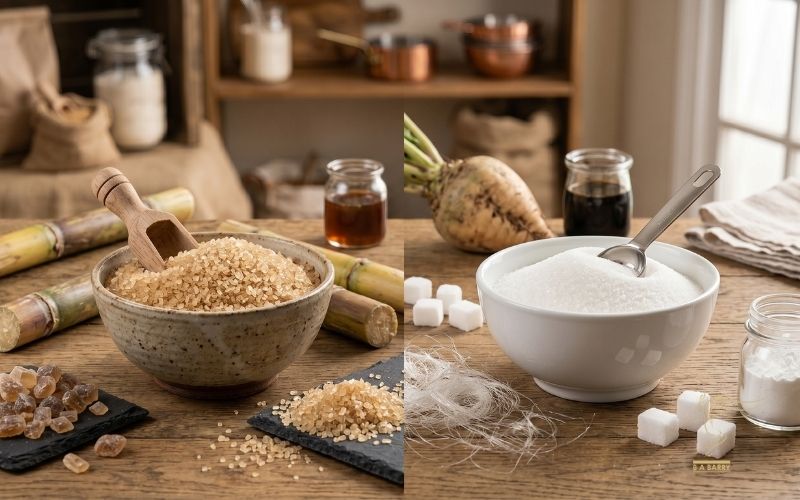
When buying sugar for your personal cooking or commercial food or beverage manufacturing applications, many people find it hard to choose between raw sugar and cane sugar. This happens mainly because they don’t know what makes each of these sugar types different.
Cane sugar and raw sugar both come from the same source, i.e., organic sugarcane. Research shows that more than 77-80% of the world’s sugar comes from sugarcane, while sugar beets account for the remaining 20-23% of the sugar trade globally. Research from FAO also shows that 1 ton of sugarcane produces roughly 100–120 kg of recoverable sugar under commercial conditions. The level of refining also determines a sugar's ICUMSA grade, if you're sourcing in bulk, it's worth understanding how ICUMSA 45 compares to ICUMSA 100 as well.
However, these sugar varieties are different in terms of flavor, taste, texture, and culinary applications. This difference is the result of different processing methods that we use to make cane sugar and raw sugar, similar to how coconut sugar differs from cane sugar due to its own distinct sourcing and processing.
This blog covers key differences between cane sugar and raw sugar in depth. So, keep on reading till the end to find the best sugar type that instantly elevates your recipes every single time. If you'd like a broader overview first, our complete guide to types of sugar is a good starting point.
What Is Raw Sugar?
What Is Cane Sugar?
Cane Sugar vs Raw Sugar: Key Differences
Raw sugar is the minimally processed form of sugar. The initial crystallization of the sugar gives you this product, which contains more of its molasses and mineral content. The presence of molasses is what imparts a rich flavor and a golden hue to raw sugar crystals.
Many people believe that raw sugar is a completely unprocessed form of sugar. This is a misconception. This sugar results from the cleaning, filtration, and crystallization of the sugarcane juice. However, this sugar doesn’t undergo intensive refining like ICUMSA 45 sugar (refined sugar).
How is it made?
Studies show that more than 108–111 countries produce sugar, and most of these use sugarcane for this purpose. Here is the brief process for the manufacturing of raw organic cane sugar.
The process starts with the harvesting of sugarcane stalks manually or with mechanical methods. The harvested stalks must reach the processing mills as soon as possible to preserve sugar quality.
At the mill, the stalks undergo cleaning. Then they are chopped and crushed through heavy rollers to extract the juice. This juice contains water, sucrose, plant fibers, minerals, and organic compounds.
After that, the clarification and purification of the juice remove most of the impurities.
Manufacturers perform heat and then lime treatment of the juice to separate impurities. Then they perform filtration. This gives you a clean sugar solution.
The clean juice is heated to remove water. This results in a more concentrated solution or a thick syrup.
This syrup is poured into vacuum pumps for further evaporation and sugar crystal formation. These crystals are mainly sucrose surrounded by molasses.
Next, the crystal-molasses mix undergoes centrifugation, which separates sugar crystals from molasses while leaving a thin molasses coating on the surface of the crystals.
These crystals are what we call raw sugar.
Key Features of Raw Sugar
Here are some key features of raw organic sugar.
Raw sugar has a golden-brown color.
The crystals of this sugar are large in size.
The flavor of raw sugar is caramel-like.
This sugar has a coarse texture and a less refined appearance.
This sugar dissolves slowly in most liquids.
Cane Sugar is a highly refined form of sugar where all the molasses has been removed. Cane sugar has a fine granulated texture, which results from its extreme processing.
In the making of this sugar, you wash, filter, and purify raw sugar until every non-sucrose element is removed. This is why about 99.9% of this sugar is sucrose, and that is what gives it a distinctive white color and neutral sweet taste.
How is it made?
The making of this sugar starts with the making of raw sugar. Further purification and processing of this sugar give you cane sugar.
Here is how the process follows.
First, mix raw sugar crystals with a warm syrup solution. This solution loosens and removes the remaining molasses from raw sugar.
Then you use centrifuges to separate impurities.
The cleaner crystals you get are then dissolved in a sugar solution.
This resulting solution undergoes filtration, which removes color components, mineral residues, organic impurities, and the remaining molasses. This gives you a highly purified sugar liquor.
This solution then passes through activated carbon or specialized filtration systems. This further removes the natural pigments of the sugar. This is where the mixture turns into a colorless solution.
This pure or clear sugar is again concentrated. This leads to the crystal formation. The crystals you get in this way are nearly pure sucrose.
The crystals undergo drying and sieving to separate uniform-sized crystals.
These uniform-sized crystals are what we know as refined sugar.
Key Features of Cane Sugar
Here are some notable features of cane sugar that set it apart.
This sugar has a bright white color.
Its crystals are uniform and very fine.
This sugar is nearly 100% sucrose.
It has a neutral, sweet flavor.
Its fine texture allows it to dissolve very quickly in most recipes.
To make a better choice when you buy organic cane sugar or raw sugar, you need to consider carefully what sets them apart. This section lists key differences between these sugar types to help you decide better.
Processing
Cane sugar undergoes heavy processing, which involves heat treatment, filtration, refiltration, centrifugation, etc.
Raw sugar is minimally refined. The sugar crystals in this case retain most of their molasses content.
Color
The removal of molasses and aggressive processing gives cane sugar a pure white color. Raw sugar has a golden, amber, or dark brown color due to the presence of molasses.
Flavor
Cane Sugar gives you a neutral flavor without any undertones. It has a straightforward, sweet taste with no influence of other flavors. Raw organic sugar gives you subtle notes of caramel, toffee, honey, and molasses.
Texture
Cane sugar has a smooth consistency, which results from its very fine and uniform crystals.
Raw sugar has bigger crystals with non-uniformity in their size. This gives it a rough texture along with a slight crunch.
Dissolving Ability
The smooth texture or very fine crystals of the cane sugar allow it to dissolve rapidly in hot drinks, cold beverages, batters, and syrups. This is what makes it a perfect cooking and baking ingredient.
Raw sugar’s large crystals do not dissolve easily. This is what limits its culinary applications to some extent.
Uses
Cane sugar has a neutral flavor. This makes it a perfect ingredient for making cookies, cakes, muffins, crème brulee, crunchy toppings, and more.
Raw sugar has a pronounced molasses flavor. This makes it a perfect ingredient for coffee, tea, hot chocolates, marinades, barbecue rubs, and gingerbread cakes.
Choosing between raw sugar and cane sugar for commercial use goes beyond flavor preference. For food and beverage manufacturers, the decision affects product consistency, regulatory compliance, processing efficiency, and cost.
When to Source Cane Sugar (Refined)
Refined cane sugar, typically graded at ICUMSA 45, is the industry standard for most commercial food applications. Its near-pure sucrose content (99.9%), neutral flavor, and fine uniform crystals make it the preferred choice for:
Carbonated beverages, juices, and energy drinks where color neutrality is critical
Confectionery and chocolate manufacturing require precise sucrose concentration
Pharmaceutical-grade applications where purity specifications must be met
Large-scale bakery operations where a consistent dissolution rate matters
Products where color stability across batches is a quality control requirement
ICUMSA 45 refined sugar also offers longer shelf life and greater resistance to microbial contamination, both important factors for manufacturers operating at scale.
When to Source Raw Sugar
Raw sugar, typically graded at ICUMSA 600–1200, is preferred when molasses content is a functional or flavor asset, or when further refining is planned in-house. Common commercial sourcing scenarios include:
Artisan food brands position products as minimally processed or "natural"
Rum, craft beer, and fermentation applications where residual molasses aids fermentation
Specialty bakery lines (gingerbread, dark caramelized products, molasses-heavy recipes) where flavor depth is part of the product identity
Sugar refineries and reprocessors sourcing raw input material for their own refining operations
Key Specifications to Check When Buying in Bulk
Before placing a bulk sugar order, always confirm the following from your supplier:
ICUMSA rating — determines color and purity level
Moisture content — affects shelf life and caking risk during storage
Sucrose percentage — critical for formulation accuracy
Origin and traceability — required for food safety audits and retailer compliance
Certifications — organic, food-grade, Halal, or Kosher, depending on your market
At BA Barry, we supply both ICUMSA 45 refined cane sugar and raw cane sugar to food manufacturers, beverage producers, and trading companies across the GCC and beyond. Our products come with full traceability documentation and are available in bulk quantities with flexible shipping options.
Cane sugar and raw sugar are both made from sugarcane. However, the processing of these sugar types is different, and that is what leads to their different colors, textures, flavors, and culinary uses.
Raw sugar is minimally processed organic sugar with a dark brown color, caramel flavor, and coarse texture. On the other hand, cane sugar is a heavily processed sugar that has a white color, very fine crystals, and a neutral flavor that doesn’t overpower other recipes.
It is important to understand what sets these sugar types apart. This can help you choose a sweetener that blends seamlessly with your recipe while meeting all of your personal recipe flavor and texture preferences every single time.
Visit us at BA Barry Group today to source high-quality organic and refined cane sugar in bulk. Our high-quality organic sugar and cocoa powder products promise exceptional purity, delicious flavor, and complete traceability at very reasonable prices.
Ready to source raw or refined cane sugar for your next production run? BA Barry supplies food-grade bulk sugar to manufacturers and traders across the GCC — with full traceability, flexible quantities, and competitive pricing.
The extent of processing of these sugars makes them unique. Raw sugar is minimally processed, which leads to its dark brown color, high molasses content, and a rich flavor. Cane sugar is heavily processed, which leads to its zero-molasses content, high sucrose content, neutral flavor, and white color.
Both sugars contain sucrose. This means both can cause a blood sugar spike if you consume them in excess.
Yes, however, the use of raw sugar can affect the recipe's flavor, color, and consistency to some extent.
Cane sugar dissolves more quickly as it has a very fine texture with small crystals.
This sugar has smaller crystals and a very smooth texture. This is what allows it to dissolve rapidly and evenly in most recipes.